Salesforce Buys Qualified: What Martech Consolidation Means for Lean B2B Teams
On April 1, 2026, it became official: Salesforce completed its acquisition of Qualified. No April Fools' joke - just a clear signal of where the martech market is heading. If you've been writing off agentic marketing as niche hype, it's time to take a closer look.
What Qualified Actually Does - and Why Salesforce Wanted It
Salesforce closed the acquisition of Qualified on April 1, 2026. The company was already deeply embedded in the Salesforce ecosystem: an AppExchange partner, Salesforce Ventures on the cap table, and a product that ran natively on Salesforce data.
At the heart of Qualified is an AI agent called "Piper." Qualified is a platform that converts website traffic directly into pipeline - its AI agent Piper engages inbound buyers in real time, scores purchase intent, answers questions, qualifies leads, and books meetings. The website becomes a fully automated conversation partner, no human intervention required.
Qualified had raised a total of $163 million across four funding rounds before Salesforce fully integrated the company. With the acquisition, Salesforce is accelerating its Agentforce Sales and Agentforce Marketing products and aims to offer a more comprehensive solution for agentic marketing.
Agentic GTM Is No Longer a Trend - It's Table Stakes
The numbers tell a clear story. According to Pavilion's 2026 GTM Benchmark, 67% of B2B companies are already using some form of AI agents in their GTM workflow - up from 23% in 2024. That's not a gradual climb. That's a tipping point.
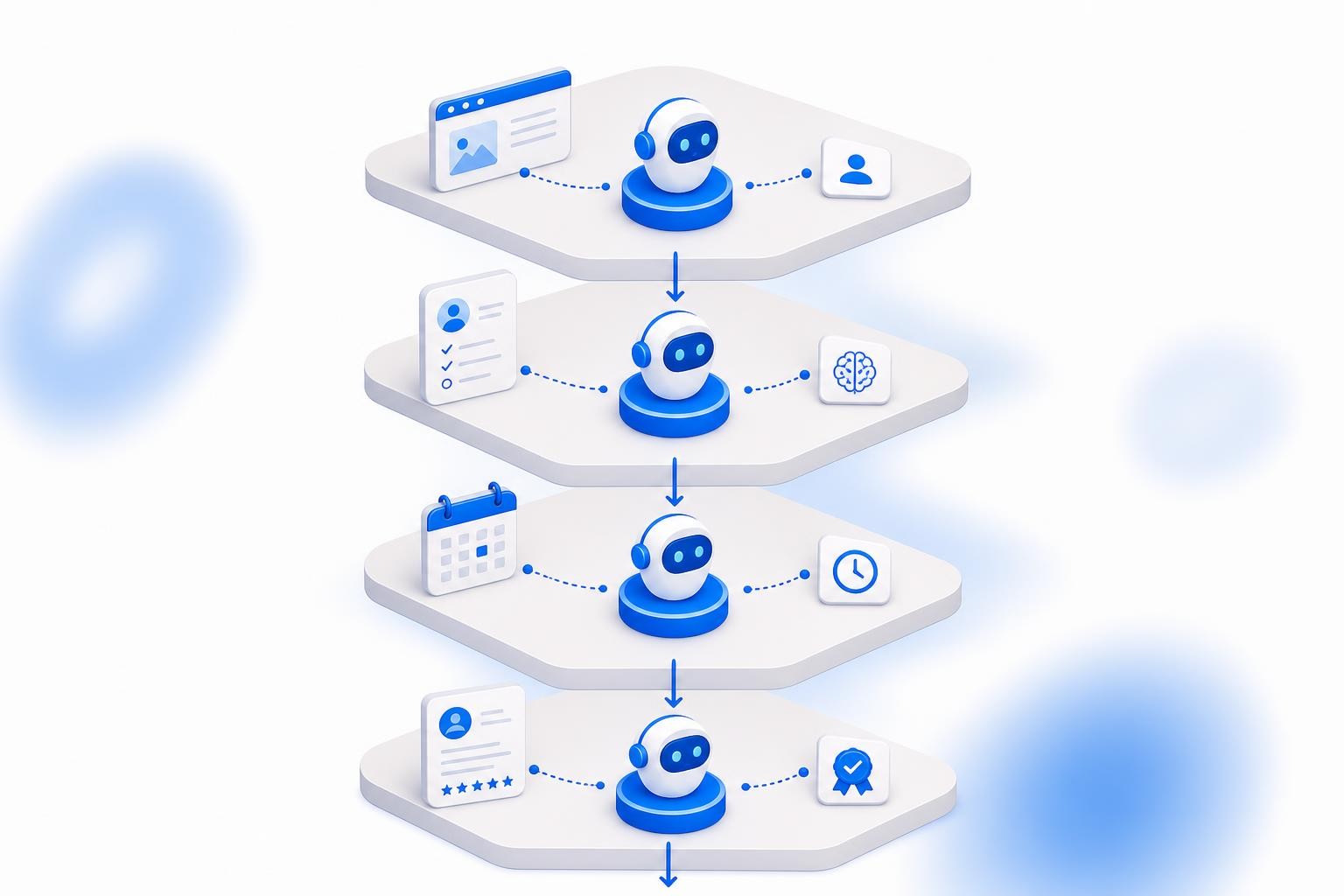
But there's an important distinction between what most companies call "AI in GTM" and actual GTM agents. Using ChatGPT for subject lines isn't an AI agent. A GTM agent is an autonomous system that takes a defined input, executes a series of actions, and produces a defined output - with minimal human involvement.
Alongside the Salesforce acquisition, signals from across the market are converging:
- Agentic AI companies have captured a disproportionately large share of the roughly $3.7 billion raised by sales, marketing, and CRM startups in early 2026 worldwide.
- Minerva launched publicly in June 2026 with $20 million in funding and a partnership with OpenAI - further proof that capital is flowing into agentic marketing.
- Microsoft sees a fundamental shift away from SEO toward AEO and GEO - while emphasizing that SEO and content investments remain the foundation for these new strategies.
The Problem: Agentforce Requires an Enterprise Stack
Here's the catch for most B2B teams. Agentforce sounds like an upgrade - but in practice it's tied to a very specific infrastructure.
Agentforce requires either Salesforce Enterprise Edition (starting at $165 per user/month) or Unlimited Edition ($330 per user/month). And that's just the starting point. Agentforce works well for service teams and Salesforce-native sales support, but struggles when GTM workflows span systems outside of Salesforce. Most advanced deployments require Data Cloud (now Data 360), which pushes real-world first-year costs for mid-market teams into the $150,000-$600,000 range.
If you don't already have a Salesforce footprint and aren't planning a Data 360 budget, Agentforce simply isn't the right starting point.
For a 20-person team, estimated first-year costs for Salesforce Agentforce run around $140,000 - including enterprise licenses, add-ons, implementation, and training.
This isn't a knock on Salesforce. Agentforce is built for organizations that have already standardized on Salesforce, have clean CRM data, and have a dedicated RevOps team to configure and maintain the agents. A 20-person B2B company typically doesn't check those boxes.
Build, Buy, or Platform - The Question for Lean Teams
The consolidation playing out across the martech market follows a clear pattern: the big suites are acquiring the best agentic marketing products and folding them into stacks that assume enterprise budgets, enterprise data, and enterprise RevOps capacity.
For lean B2B teams, that creates three options:
Build it yourself - stitch together AI agents from individual components. Technically possible, but without dedicated engineering resources it's hard to scale and harder to maintain.
Buy individual agents - license tools for specific tasks. The problem: AI agents without a strategy, without visibility, and without a content motion are sending outreach into a market that already built its shortlist without you.
Use an operated platform - a platform that covers the entire GTM motion without requiring you to build your own RevOps team.
What This Means for Your Team in Practice
AI in B2B GTM is everywhere in 2026 - 96% of marketers say they're using it. But only 6% qualify as high performers where AI measurably impacts revenue, according to Demand Gen Report's 2026 B2B Trends Research. The gap between adoption and impact is the real problem.
The reason for that gap usually isn't a lack of budget for AI tools. It's the absence of a coherent motion: strategy, content, visibility, distribution, and measurement need to run as one system - not as a collection of standalone agents.
According to Pavilion's 2026 GTM Benchmark, AI-assisted GTM generates roughly 40% more pipeline per rep. But that effect only kicks in when the AI is built on a clear strategy and a functioning content foundation - not when it's running in a vacuum.
That's exactly where the opportunity lies for lean B2B teams: not replicating Agentforce, but applying the same logic - strategy as context, AI execution, human judgment - at a fraction of the budget.
Nukipa: The Full GTM Motion, Without the Enterprise Stack
Nukipa is built for exactly this situation. Instead of licensing and operating an enterprise stack yourself, you get a GTM engineer who runs the entire motion for you - on the Nukipa platform, which holds strategy, AI content creation (SEO/GEO/AEO), publishing, distribution, and measurement together as one connected system.
In practice, that means:
- Strategy as living context - ICP, USP, and buyer journey are defined once and serve as the foundation for every piece of content, every campaign, every sequence.
- AI content for SEO and GEO - content that ranks in Google and gets cited in AI answers (ChatGPT, Perplexity, Google AI Overviews).
- Operations, not deliverables - you set the direction, Nukipa runs the motion.
All for around $490/month - instead of six-figure enterprise first-year costs.
Launch your AI-powered GTM motion – no enterprise stack, no RevOps team required.
Try Nukipa NowMartech consolidation doesn't make agentic marketing inaccessible. It makes it more urgent to choose the right level for your team size - before the market builds its shortlist without you.
What exactly is Agentic Marketing?
Agentic Marketing refers to the use of autonomous AI agents that independently plan, execute, and optimize marketing and GTM tasks – from lead qualification and content creation to meeting booking – with minimal human intervention.
Why did Salesforce acquire Qualified?
Qualified fills a gap in Agentforce: the moment before a buyer speaks with a rep – the website visit. Piper's AI agent qualifies inbound visitors in real time and autonomously books meetings. This adds a production-ready marketing front end to Agentforce Sales and Agentforce Marketing.
Can a small B2B team use Agentforce?
Technically yes, but the requirements are steep: Salesforce Enterprise Edition (at least $165/user/month), clean CRM data, and ideally a dedicated RevOps team. For teams without an existing Salesforce stack, first-year costs are often five to six figures.
What is the difference between SEO, GEO, and AEO?
SEO optimizes for traditional search engine rankings. GEO (Generative Engine Optimization) makes content discoverable and positionable as a trusted source in AI-powered search. AEO (Answer/Agentic Engine Optimization) optimizes content so that AI assistants and agents can use it directly as an answer.
What makes Nukipa different from a traditional marketing agency?
Nukipa operates the entire GTM motion – strategy, organic and paid lead generation, content, nurturing, and reporting – as one cohesive system on its own AI platform. An agency delivers outputs that you have to manage yourself. Nukipa takes care of the operations.
Related
Google AI Mode Cut Clicks by 18.8 Points in a Randomized Study. Search Console's New AI Report Can't Tell You Where You Stand.
A preregistered randomized study found Google AI Mode cut click-through to external sites by 18.8 points, while Search Console's new AI report still has no clicks and no position. What B2B teams can and can't measure.
ChatGPT Ads Are Seven Months Old and Still Stuck at Test Budgets. Here's the Measurement Checklist Before You Spend.
Seven months after launch, ChatGPT ads still sit at test budgets because measurement doesn't hold up: click counts that disagree 5:1, conversions that never show, and tracking terms legal teams won't sign. Here's the checklist a lean B2B team needs before spending.
51% of B2B Software Buyers Now Start Research in a Chatbot. Your Analytics Sees None of It.
G2's 2026 buyer survey: 51% of B2B software buyers now start research in an AI chatbot, 69% switched their vendor pick based on what it said, and none of it shows up in your analytics. Here's why the AI dark funnel is structurally different from the old one, and what to do about it.